Malaysia is at the center of a digital transformation that is reshaping Southeast Asia’s economy. Technology adoption is accelerating across industries, forcing businesses to adapt or risk being left behind.
This article examines the key trends, challenges, and opportunities shaping Malaysia’s digital economy in 2025. From the surge in e-commerce to the rapid adoption of digital finance, we highlight where growth is happening and how businesses can position themselves to benefit.
Whether you are scaling a startup or managing an established enterprise, understanding these shifts will help you make informed decisions, capture new opportunities, and build resilience in Malaysia’s digital-first economy.
What Defines Malaysia’s Digital Economy in 2025?
Malaysia’s digital economy is expanding quickly, supported by strong consumer demand and government initiatives such as the MyDIGITAL blueprint and Malaysia Digital (MD) Initiative managed by by the Malaysia Digital Economy Corporation (MDEC).
- E-commerce — The sector recorded a Gross Merchandise Value (GMV) of RM68 billion (source), reflecting a sharp rise in online spending. While B2C platforms dominate, the B2B e-commerce market remains underdeveloped.
- Digital finance — E-wallet and cashless transactions grew to RM69 billion in 2022, with forecasts reaching RM95 billion by 2025. Businesses that adopt digital payment solutions are already seeing faster transaction speeds and improved customer engagement.
- ICT adoption — Cloud platforms, managed IT services, and cybersecurity solutions are becoming the backbone of business operations, helping companies scale while reducing risks.
In short, Malaysia’s digital economy in 2025 is defined by fast-growing consumer markets, rising digital transactions, and the need for ICT infrastructure that supports secure, scalable growth.
What Regional Trends Are Emerging Across Klang Valley and Beyond?
While national policies shape the broad direction, digital adoption varies across Malaysia’s regions.
- Klang Valley as the digital hub — Home to Kuala Lumpur, Petaling Jaya, and Cyberjaya, the Klang Valley remains the center of Malaysia’s e-commerce, fintech, and startup ecosystem. High internet penetration and strong ICT infrastructure make it the most mature digital market.
- Johor and Penang as industrial adopters — Johor’s manufacturing base and Penang’s electronics cluster are increasingly digitizing supply chains, adopting cloud-based ERP systems, and investing in cybersecurity to protect global exports.
- East Malaysia catching up — Sabah and Sarawak face slower adoption due to infrastructure gaps, but government projects such as the JENDELA initiative are expanding high-speed broadband access and creating new opportunities for rural e-commerce and digital services.
For businesses, this means strategies must be region-sensitive. A solution that works seamlessly in the Klang Valley may need additional infrastructure support in East Malaysia. Recognizing these differences helps companies capture opportunities nationwide while aligning with government investment priorities.
How Is E-Commerce Shaping the Market?
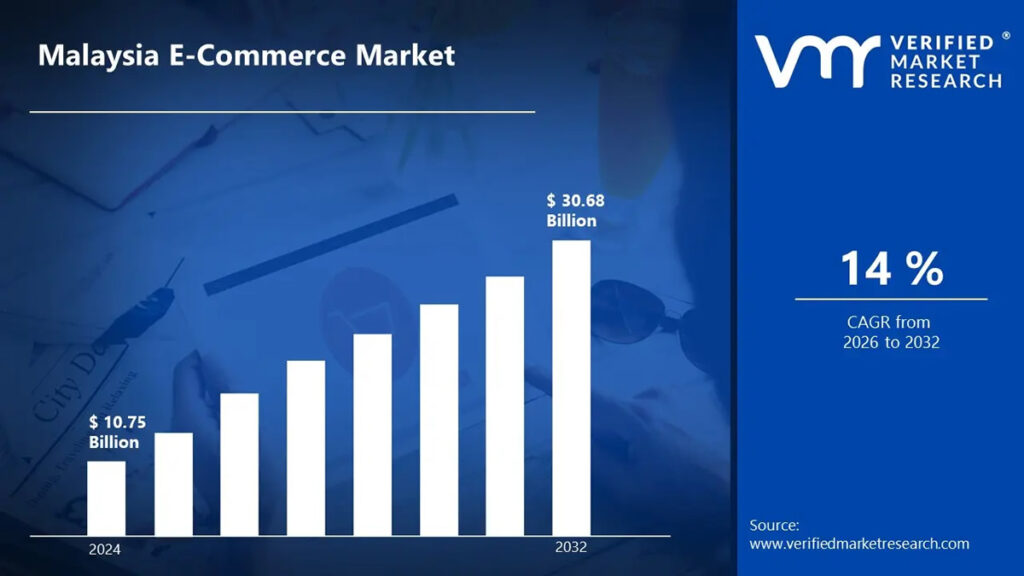
E-commerce continues to be a cornerstone of Malaysia’s digital economy. The market was valued at US $10.75 billion in 2024 and is projected to surpass US $12.26 billion in 2025, with a 14.3 % CAGR forecasted through 2030. Growth is no longer limited to online retail — it now extends into manufacturing, services, and cross-border trade.
Several powerful trends are reshaping the e-commerce landscape:
Mobile Commerce (M-Commerce) Growth and Optimization
Consumers increasingly prefer the convenience of mobile shopping. This shift makes mobile-first design and optimization essential for any business entering the market.
- M-commerce’s share of total e-commerce sales grew from 48 % in 2020 to 76 % in 2023.
- Mobile shopping app downloads surged 157 % between 2020 and 2023.
- In 2023, 82 % of Malaysian online shoppers made at least one purchase via smartphone.
Social Commerce and Live Shopping
Social platforms have evolved into direct sales channels. Community-driven engagement and live sales formats are becoming mainstream in digital retail. Businesses now leverage targeted ads, influencer marketing, and integrated checkout on TikTok and Shopee Live.
- Social commerce value jumped from RM 3.2 billion in 2020 to RM 8.9 billion in 2023.
- Live shopping events generated RM 2.1 billion in sales in 2023.
- 68 % of Malaysian online shoppers have purchased directly through social media.
Buy Now, Pay Later (BNPL) and Digital Payment Innovation
Flexible payment solutions are transforming how Malaysians shop online. E-wallets, BNPL, and alternative digital payments are reshaping consumer expectations. For businesses, adopting diverse payment methods has became a competitive requirement to capture Malaysia’s increasingly digital-first consumer base.
- BNPL transactions rose by 320 % between 2020 and 2023, reaching RM 2.9 billion.
- Digital wallet transactions in e-commerce increased from RM 15.7 billion in 2020 to RM 47.3 billion in 2023.
- 78 % of online merchants now offer at least three digital payment options.
Why B2B E-Commerce Remains Underdeveloped?
Despite gains in B2C, the B2B e-commerce segment remains underleveraged, offering a strategic growth opportunity. Current enablers include:
- National e-Commerce Strategic Roadmap — Under this, the government aims to support 875,000 MSMEs in adopting e-commerce by 2025, fostering a digitally inclusive business environment.
- High digital readiness — With nearly universal internet access and pervasive smartphone usage, businesses are increasingly primed for digital transactions.
- Operational efficiencies — Online platforms can streamline ordering, logistics, and payments, which reduce delays and manual overhead.
Examples from the consumer side show what’s possible. Grab and Foodpanda reshaped food delivery using mobile commerce. Their models highlight how B2B services could digitize order processing, inventory, and supply chain management in a similar way.
Moreover, social commerce is expanding into B2B, with platforms like Facebook, LinkedIn, TikTok, and even Shopee increasingly used for outreach, networking, and sales.This evolution allows businesses to sell and collaborate directly within the channels where clients already spend time.
Agile companies that build robust B2B infrastructure now stand to gain a competitive edge as the market evolves.
How Is Digital Finance Powering Transactions?

Digital finance sits at the center of Malaysia’s digital economy, driving how money moves between consumers, businesses, and governments. In 2022, e-wallet transactions reached an impressive RM69 billion and are expected to climb to RM95 billion by 2025. This significant uptake of digital payment methods highlights the growing trust and reliance on digital finance among consumers and businesses alike. It signals a major shift towards digital transactions, setting the stage for a more connected and streamlined economic environment.
This growth reflects more than just convenience. It represents a fundamental shift in financial behavior:
- Mainstream adoption — Platforms like GrabPay, Touch ’n Go eWallet, and GX Bank now dominate everyday transactions, from ride-hailing and food delivery to bill payments and retail shopping.
- Financial inclusion — Digital wallets extend basic financial access to underserved and unbanked populations, offering services like microloans, savings, and insurance.
- Business impact — SMEs benefit from faster settlements, lower transaction costs, and improved cash flow visibility when adopting e-wallets and QR-based payments.
- Regulatory support — Bank Negara Malaysia has introduced incentives and licensing frameworks for digital banks and fintech operators, reinforcing trust and security in the system.
Looking ahead, digital finance will not only power everyday transactions, but also create new layers of fintech services, including buy now pay later (BNPL), peer-to-peer lending, and cross-border e-wallet interoperability. Together, these trends are reshaping Malaysia into a cash-light, digitally integrated economy.
Where Are the Biggest Opportunities for B2B Tech Startups?
Despite significant advancements, there’s a notable gap in the digitalization of back-end operations among Malaysian businesses, where only about 30% have adopted digital technologies for these purposes. This leaves a substantial market, estimated between RM7 to RM14 billion, wide open for B2B tech startups according to Twimbit’s research.
The demand for solutions that can scale securely, automate processes, and reduce operational friction continues to grow.
Artificial Intelligence (AI)
AI is becoming a priority across industries. Companies are looking to AI to analyze large volumes of data, optimize supply chains, and personalize customer experiences. Adoption is already visible in areas such as retail analytics, predictive maintenance in manufacturing, and risk scoring in financial services. Startups offering AI-as-a-service or industry-specific models are well positioned to grow.
At Callnet Solution, we have expanded our capabilities in this space by partnering with MindHive to deliver custom enterprise AI solutions tailored to Malaysian businesses.
Cybersecurity
Cybersecurity is another urgent frontier. With rising threats, businesses need solutions that can protect sensitive data, detect intrusions, and remediate breaches quickly. Enterprises must also comply with local frameworks such as the PDPA and international standards like ISO 27001. B2B startups that provide managed security services, ransomware protection, and endpoint detection platforms are helping fill the resource and expertise gap for both SMEs and large corporations.
Enterprise Cloud Solutions
Enterprise cloud solutions are equally critical. As hybrid and multi-cloud adoption becomes mainstream, organizations require platforms that can deploy workloads efficiently, integrate with legacy systems, and maintain compliance. Startups focusing on cloud-native development, Kubernetes orchestration, and secure migration services are seeing increased demand, especially from firms balancing cost optimization with performance requirements.
Beyond these three major areas, further opportunities exist in fintech infrastructure, such as APIs for cross-border payments and embedded finance, as well as SaaS applications built for vertical industries like logistics, hospitality, and healthcare. Another emerging space is sustainability tech, where startups are building tools that help enterprises monitor, report, and optimize energy use to meet ESG goals.
In short, Malaysia’s B2B startup landscape offers opportunities wherever technology can solve enterprise pain points — whether that is scaling operations securely, automating workflows, or ensuring compliance in a fast-changing regulatory environment.
What Role Do ICT Services Play in Malaysia’s Digital Economy?
ICT services are the backbone of Malaysia’s digital economy. They provide the infrastructure, security, and scalability businesses need to compete in a connected market. From SMEs to large enterprises, organizations depend on ICT to keep operations running smoothly while embracing new technologies.
Managed IT services support, troubleshoot, and optimize daily systems so teams can stay focused on business growth rather than IT disruptions. Cybersecurity solutions protect and detect threats, ensuring compliance with frameworks such as the Personal Data Protection Act (PDPA). Cloud platforms scale and integrate applications, giving enterprises the agility to expand into new markets without heavy upfront infrastructure costs.
At the same time, challenges remain. Many firms face skills shortages in advanced areas like AI, cloud engineering, and data analytics. Compliance with regional and global standards can be complex, while SMEs often struggle to balance cost with digital maturity. Strategic ICT partnerships can close these gaps by delivering expertise, shared infrastructure, and reliable support.
This is where IT providers and system integrators like Callnet Solution play a role. By combining managed IT, enterprise cloud integration, and cybersecurity, ICT services help Malaysian businesses operate securely, meet compliance needs, and scale efficiently.
How Can Businesses Capture Malaysia’s Digital Opportunities?
The opportunities within Malaysia’s digital economy are clear, but businesses need the right approach to capture them effectively.
First, you should assess your digital infrastructure to identify bottlenecks, whether that means outdated servers, weak security practices, or poor cloud adoption. Next, prioritize investments in scalable platforms — for example, hybrid cloud solutions that allow workloads to expand on demand. Businesses should also adopt secure digital payment systems to meet consumer expectations, while ensuring compliance with PDPA and other relevant frameworks.
Partnerships are another essential step. Rather than building everything in-house, companies can work with trusted ICT partners who provide managed IT support, cloud solutions, and cybersecurity expertise. This reduces risk and accelerates digital transformation without heavy upfront cost.
Finally, businesses should run pilot projects to test new digital models in low-risk environments before scaling. Whether it’s adopting AI-driven analytics or exploring B2B e-commerce platforms, pilot programs allow you to validate solutions before making larger commitments.
Conclusion: Turning Strategy into Action
Malaysia’s digital economy is moving fast, and businesses that act now will secure the biggest advantages. The right ICT partner can help you turn strategy into measurable results — from stable IT operations to scalable cloud adoption.
Callnet supports Malaysian enterprises with Managed IT Services and Cloud Solutions, giving you the tools to grow securely in a digital-first world.
Take the first step today. Reach out to our team for a free consultation and start building your path into Malaysia’s digital future.