Choosing between hybrid cloud and public cloud shapes how a Malaysian business runs its workloads, controls cost, and meets its PDPA obligations. Public cloud rents shared infrastructure from a provider and bills by usage. Hybrid cloud connects that public capacity to a private environment the business controls directly, so regulated data stays where you can prove its location.
This guide compares the two models, sets out the decision criteria that matter for retail, hospitality, healthcare, finance, and professional services, and lists what to prepare before you migrate.
What is the difference between public cloud and hybrid cloud?
The difference between public cloud and hybrid cloud comes down to where each workload runs and who controls the underlying infrastructure.
Public cloud hosts workloads on shared, multi-tenant infrastructure that a provider owns, operates, and secures up to a defined responsibility line. Private cloud dedicates infrastructure to a single organization, whether on-premises or in a hosted data center, and grants the business direct control over configuration and data location. Hybrid cloud connects a private environment to public cloud capacity, so a business runs regulated or latency-sensitive workloads privately and scales the rest into the public tier.
The practical result matters for compliance: hybrid cloud lets a Selangor or Johor business pin personal data to a known location while still renting elastic compute for seasonal peaks.
| Dimension | Public cloud | Private cloud | Hybrid cloud |
|---|---|---|---|
| Tenancy | Shared, multi-tenant | Single-tenant, dedicated | Mixed across both tiers |
| Cost model | Usage-based operating cost | Higher upfront capital cost | Blended, workload by workload |
| Scalability | Scales on demand quickly | Limited by owned capacity | Scales public tier, holds private tier |
| Data-location control | Provider region choices | Full control | Full control for the private tier |
| Security responsibility | Shared with provider | Rests with the business | Split by where the workload sits |
| Best-fit workload | Variable, low-residency-risk | Stable, sensitive, regulated | A mix of both profiles |
Read the table as a spectrum of control against management effort: public cloud reduces the operational load, private cloud maximizes control, and hybrid cloud places each workload on the tier that suits its risk and demand.
When does public cloud fit a Malaysian business?

In our experience, the conversation isn’t simply about public versus hybrid cloud. The real challenge for businesses is how to implement whichever model they choose in a way that is secure, cost-effective, and aligned with their compliance obligations.
Too often, organizations underestimate the complexity of governance, monitoring, and integration. And that’s usually where costs spiral or risks increase.
At Callnet Solution, we focus on building practical frameworks. Think workload classification, zero-trust security, FinOps, network resilience, and so on… so that our clients see measurable value from their cloud investments with minimum unpleasant surprises.
Alan Leong
CallNet Solution Technical Director
Public cloud fits a Malaysian business when workloads scale unpredictably, carry low data-residency risk, and reward a usage-based cost model. Public cloud provisions extra compute within minutes, so a business absorbs traffic spikes without buying hardware that sits idle afterward. The provider patches the platform, maintains the data center, and secures the infrastructure up to the shared-responsibility line, which removes the need to staff those tasks in-house. A Penang e-commerce brand running seasonal campaigns, a Klang Valley startup validating a new app, and a marketing agency rendering media all match this profile because their demand swings and their data rarely triggers strict residency rules.
Well-planned cloud integration keeps these public workloads governed rather than sprawling, with cost controls and identity policies applied from the start.
When does hybrid cloud fit better?
Hybrid cloud fits better when a business processes regulated personal data, runs legacy systems that resist a full public migration, or needs predictable performance for on-site operations. It keeps sensitive workloads in a private environment where the business controls data location and access, then bursts variable workloads into public capacity.

The Personal Data Protection Act 2010 (PDPA) governs how a Malaysian business collects, processes, and stores personal data, and the Personal Data Protection (Amendment) Act 2024 revised the cross-border transfer framework so controllers now assess whether a destination provides adequate protection before data leaves Malaysia. Hybrid cloud simplifies that assessment by holding regulated records in a known location and moving only non-sensitive processing offsite. A private tier also strengthens ransomware resilience, so pairing hybrid cloud with disciplined backup and disaster recovery protects the records a business cannot afford to lose. Where sensitive workloads sit on the private tier, managed cybersecurity monitoring watches both environments under one policy instead of two disconnected setups.
What do retail, hospitality, healthcare, finance, and professional services workloads need?
Retail, hospitality, healthcare, finance, and professional services workloads need different balances of latency, data residency, and scalability, and that balance points each sector toward a different model. The following five profiles show how workload shape drives the decision.
- Retail: Retail workloads swing with promotions and festive peaks, so public cloud absorbs the surge for the online storefront while the point-of-sale and loyalty records that identify customers stay on a private tier for residency control.
- Hospitality: Hospitality workloads span booking engines, property management, and guest Wi-Fi, so a hotel group across Kuala Lumpur and Penang scales the public-facing booking layer while keeping guest identity and payment records in a controlled environment.
- Healthcare: Healthcare workloads carry sensitive patient data under PDPA, so a clinic keeps records and imaging on a private tier with strict access control and routes only anonymized analytics or scheduling into public cloud.
- Finance: Finance workloads face audit, retention, and residency scrutiny, so a Selangor accounting or lending firm anchors core ledgers privately and uses public capacity for reporting, testing, or customer-portal traffic.
- Professional services: Professional services workloads center on client documents and collaboration, so a legal or engineering practice keeps confidential matter files private and adopts public productivity tools for email, storage, and video.
Each profile mixes both tiers rather than choosing one outright, which is why most regulated Malaysian businesses land on a hybrid design.
How should you choose between hybrid and public cloud?
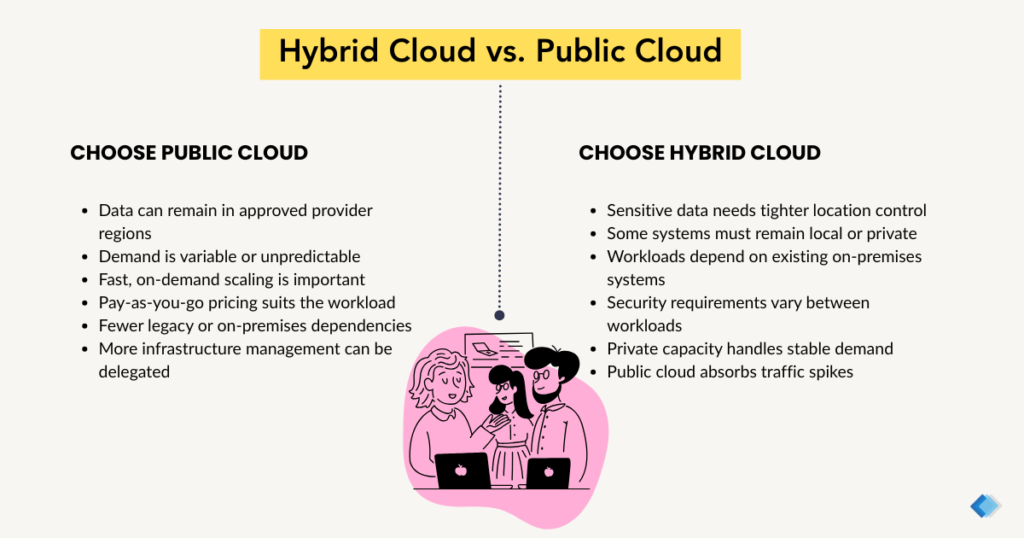
Choose between hybrid and public cloud by scoring each workload against a short set of criteria rather than picking one model for the whole business. Rate every application on the six factors below, then place it on the tier that its scores favor.
- Data residency and PDPA exposure: Judge how much personal data the workload processes and whether its records must stay in a provable location. High exposure moves the workload toward a private tier.
- Latency and location: Measure how close the workload must sit to users, devices, or on-site equipment. Latency-sensitive operations, such as a factory floor or a busy branch, favor local or private hosting.
- Scalability pattern: Identify whether demand stays flat or spikes. Spiky, unpredictable demand favors public cloud; steady demand suits a dedicated private tier.
- Cost model: Compare a usage-based operating cost against a capital investment in owned capacity. Variable workloads reward the public pay-as-you-go model; predictable ones can justify private capacity.
- Control and security responsibility: Decide how much of the security and configuration burden the business will carry versus delegate. Higher required control points to private or hybrid hosting.
- Integration with existing systems: Check how tightly the workload depends on legacy applications or on-premises systems. Deep dependencies favor hybrid cloud so old and new components connect cleanly.
Score most workloads toward public cloud and you likely want a public-first design; score several toward private on residency or latency and a hybrid design fits your business.
What should you prepare before migrating?
Prepare five things before migrating so the move validates cleanly instead of stalling midway. Complete these steps in order before any workload cuts over.
- Assess workloads: Inventory every application, its dependencies, and its performance baseline so you know what moves, what stays, and what needs re-platforming first.
- Classify data: Label records by sensitivity and PDPA exposure so regulated personal data maps to the private tier and non-sensitive data is cleared for public cloud.
- Size and cost: Model the target capacity and forecast the running cost per workload so the usage-based bill holds no surprises after cutover.
- Plan connectivity and security: Design the network link between the private and public tiers, then extend identity, access, and monitoring policy across both so security stays consistent.
- Set recovery targets: Define an RTO and RPO for each workload and confirm that backup and recovery meet them before you depend on the new environment.
A staged migration that assesses, classifies, and validates each wave lowers risk, which is where an experienced managed IT services partner keeps timelines and compliance on track. If you want a second opinion on which workloads belong on which tier, a short consultation call maps your estate before you commit.
Which cloud model fits your business?
The right model depends on your workloads, not on a single verdict for hybrid or public cloud. A business with variable, low-residency-risk applications gains speed and cost flexibility from a public-first design. A business that processes regulated personal data, runs on-site systems, or answers to auditors gains control and compliance headroom from a hybrid design that keeps sensitive records in a known location. Most Malaysian SMEs across the Klang Valley, Selangor, Johor, Penang, and the wider West Malaysia market land somewhere in the middle, running a hybrid mix that matches each workload to the tier it suits.
Callnet Solution Sdn Bhd plans, migrates, and manages cloud environments for Malaysian businesses, and reviews your workloads against cost, latency, and PDPA constraints before recommending a model.
Book a free consultation to map your workloads and choose a cloud model with confidence.